
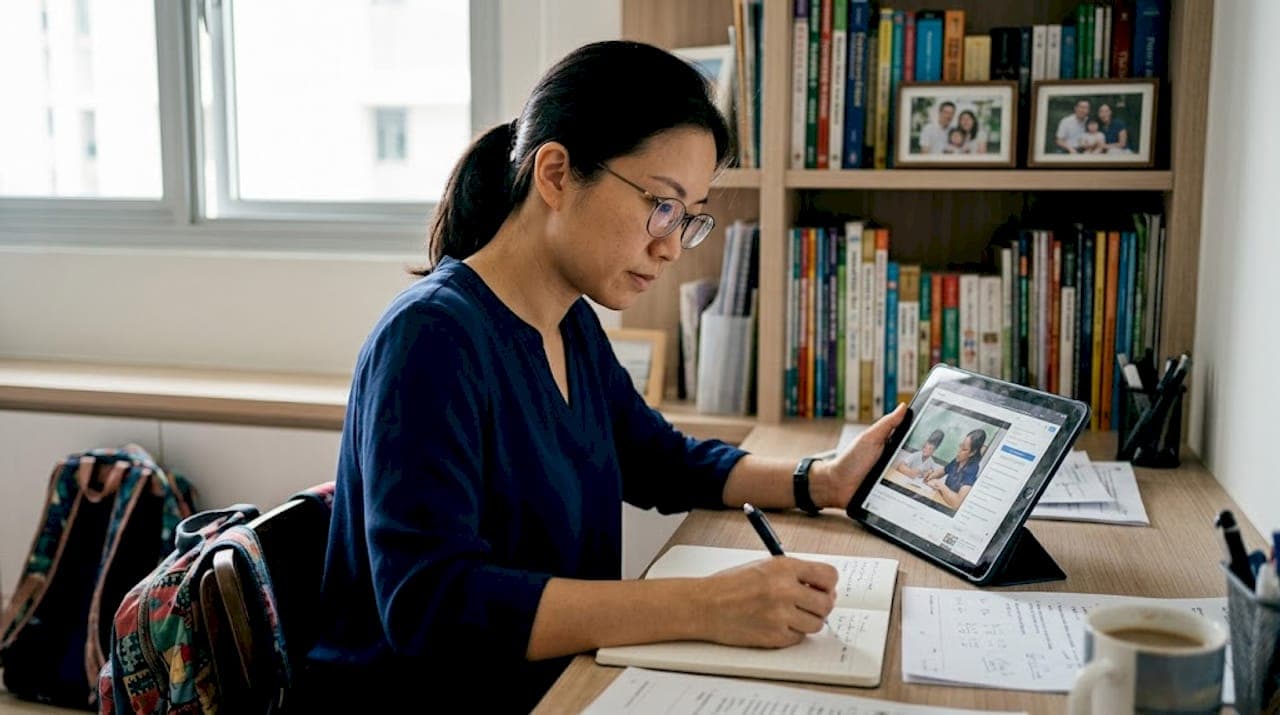
Singapore families pour enormous sums into private tutoring every year, yet many parents finish a school term wondering whether the investment actually moved the needle for their child. When it comes to Math and Science, where conceptual gaps can compound quickly, choosing the wrong tutor or failing to monitor progress can cost your child valuable months. This guide gives you a practical, step-by-step framework to measure whether your child's online tutor is genuinely driving improvement, so every dollar you spend works harder.
Table of Contents
- Understanding tutor effectiveness: What should you look for?
- Preparation: What information should you gather before evaluation?
- Execution: How to assess online tutor performance using evidence
- Verification: Signs of effective tutoring and common pitfalls
- Why most parents underestimate the importance of learning environment
- Find the right online Math and Science tutor in Singapore
- Frequently asked questions
Key Takeaways
| Point | Details |
|---|---|
| Define effectiveness clearly | Focus on both academic progress and genuine student engagement when evaluating a tutor’s impact. |
| Prepare baseline data | Record your child’s scores, environment, and learning needs before starting online tutoring. |
| Use evidence-based assessment | Monitor and evaluate tutor performance using digital tools, feedback, and consistent progress tracking. |
| Watch for warning signs | Be alert to stagnation, lack of engagement, or superficial results that indicate poor tutoring quality. |
| Value learning environment | Choose tutors who build reasoning skills and a supportive climate, not just exam rehearsals. |
Understanding tutor effectiveness: What should you look for?
With the scale of investment parents make, let's clarify what "effectiveness" actually means for Math and Science tutors in Singapore.
Effectiveness is not just about whether your child passes the next test. It covers three connected areas: measurable academic improvement, consistent student engagement, and feedback that is customized to your child's specific gaps. In Math and Science, a student who memorizes steps without understanding the underlying concept will hit a ceiling quickly, especially as topics build on each other from Primary 5 through O-Level.
Singapore's private tutoring spend reached S$1.8 billion in 2023, a 30% increase since 2018. That figure reflects just how seriously families here take academic support. But high spending alone does not guarantee results, and the same research notes that regulation and accreditation of tutors remain areas of concern. Parents need their own evaluation tools.
Online tutoring adds a layer of complexity. Unlike face-to-face sessions, you cannot observe body language or classroom energy directly. This means you need to look for structured interaction, diagnostic data, and attendance consistency as proxies for quality. A good online tutor should be assessing tutor performance through regular checks, not just delivering content and hoping it sticks.
Key markers of effectiveness to track:
- Consistent improvement in school-based test scores and homework quality
- Active participation during live sessions, not passive listening
- Personalized feedback that addresses your child's specific error patterns
- Transparent communication with parents about progress and next steps
- Clear lesson structure with objectives stated at the start of each session
| Criteria | In-person tutoring | Online tutoring |
|---|---|---|
| Engagement visibility | Easy to observe directly | Requires structured check-ins |
| Diagnostic data | Often informal | Can be highly systematic |
| Feedback delivery | Immediate, verbal | Can be written, recorded, and reviewed |
| Attendance tracking | Manual | Digital logs available |
| Parent communication | Ad hoc | Can be scheduled and documented |
When you look at primary level math tutoring options, ask specifically how the tutor measures and reports each of these criteria. The answer will tell you a great deal about their professional standards.
Preparation: What information should you gather before evaluation?
Once you know what effectiveness means, you need a baseline and context to make a fair assessment.
Before you can judge whether a tutor is working, you need to know where your child started. Collect your child's most recent report card, CA (Continual Assessment) results, and any marked test papers. Note the specific topics where marks were lost. In Math, this might be fractions or algebra. In Science, it could be the water cycle or energy concepts. Specific data beats general impressions every time.
Next, record the learning environment. Does your child have a quiet, dedicated study space at home? Is there reliable internet access and a suitable device? Are there younger siblings or other distractions during session time? MOE supports supervised in-school settings for students whose home environments are not conducive to learning, which tells you how seriously the ministry takes this factor. A chaotic home setup can undermine even the best tutor's efforts.
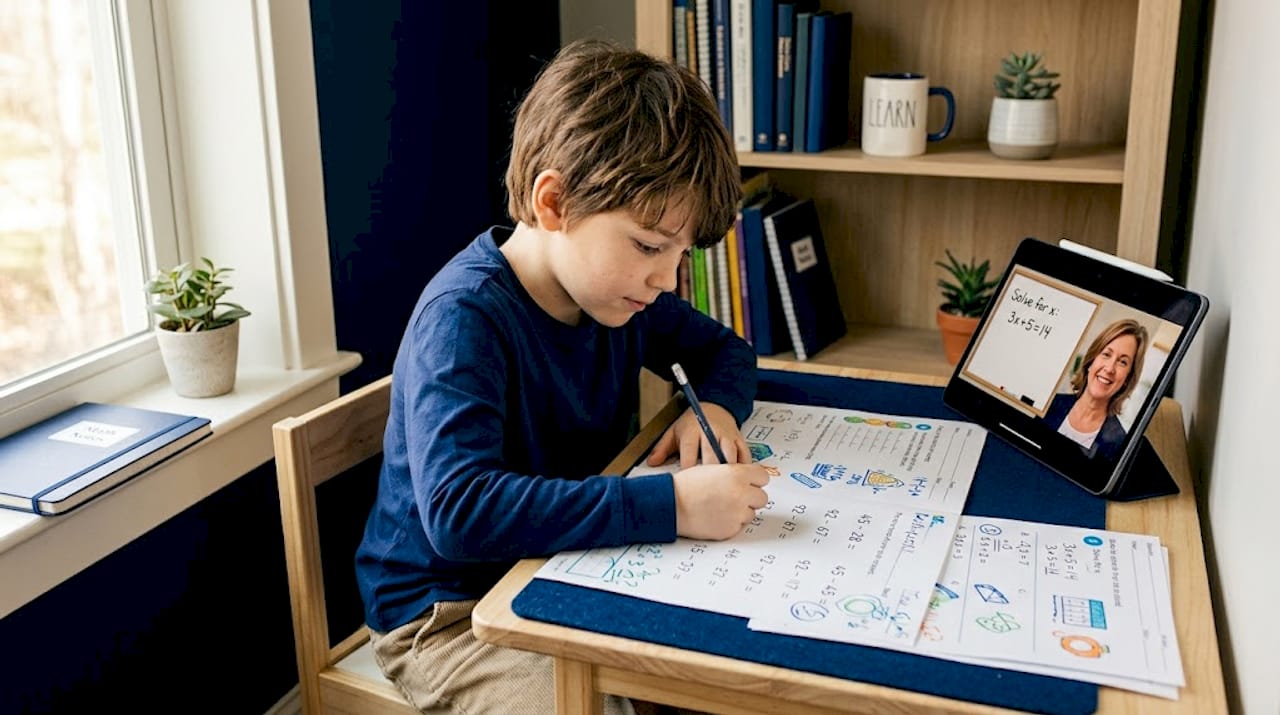
Set clear, measurable learning outcomes before the first session. "I want my child to improve" is too vague. "I want my child to move from a C to a B in PSLE Math by the next school exam" gives you a target you can actually track. Write it down and share it with the tutor so you are both aligned.
| Data to collect | Why it matters | How to get it |
|---|---|---|
| Recent test scores by topic | Establishes baseline gaps | School report card, marked papers |
| Attendance and punctuality | Signals commitment | Tutor's digital records |
| Assignment completion rate | Reflects effort outside sessions | Tutor feedback, student log |
| Home environment quality | Affects focus and learning | Parent observation |
| Device and internet reliability | Affects session quality | Test before enrollment |
Pro Tip: Keep a simple spreadsheet from day one. Log each session date, the topic covered, any assignment given, and your child's score on related work. After six to eight weeks, patterns become very clear. You will see whether scores are trending up, whether certain topics remain stuck, and whether the tutor is covering new ground or recycling the same content.
For primary 6 math classes and secondary school math tutoring, this baseline data is especially important because both levels involve high-stakes exams where even a few marks can shift a grade band.
Execution: How to assess online tutor performance using evidence
Now you're ready to actively measure your tutor's impact and teaching quality.
Systematic evaluation happens in real time, not just at the end of a term. Here is a practical step-by-step approach you can apply from the first month of tutoring.
-
Request a diagnostic assessment in the first two sessions. A strong tutor should identify your child's specific knowledge gaps early, not just follow a generic syllabus. Ask to see the results and how the tutor plans to address them.
-
Monitor session recordings when available. Many online platforms record live lessons. Review a recording once a month to check whether your child is actively answering questions, or sitting quietly while the tutor talks. Active recall (being asked to solve problems during the session) is far more effective than passive listening.
-
Check assignment quality and turnaround. Assignments should be marked with specific comments, not just a score. "Wrong" written on a paper tells your child nothing. "You applied the wrong formula here because you misread the question type" teaches them something.
-
Schedule a monthly parent update. A professional tutor should be able to tell you which topics have improved, which still need work, and what the plan is for the next four weeks. If a tutor cannot give you this, that is a red flag.
-
Use school-based tools as a cross-check. SLS V2 supports data-informed teaching and customization, meaning your child's school performance data can complement what the tutor reports. Compare both sources to get a fuller picture.
"The best tutors don't just teach content. They teach students how to think about problems, catch their own errors, and build the confidence to attempt difficult questions independently."
Pro Tip: Use your child's school-based exam feedback alongside tutor reports. If the school exam shows improvement in the exact topics the tutor has been targeting, that is strong evidence the tutoring is working. If school results and tutor reports don't align, ask the tutor to explain the gap.
For students in secondary 3 math tutoring or preparing for O-Level math classes, the stakes are higher and the evidence bar should be higher too. At these levels, you want to see improvement in structured problem-solving, not just formula recall.
Verification: Signs of effective tutoring and common pitfalls
After gathering your evidence, it's time to judge whether your student's experience matches the hallmarks of effective tutoring, and avoid common traps.
Genuine tutoring effectiveness shows up in specific, observable ways. Your child starts attempting harder questions without immediately giving up. They begin to explain their reasoning when they get an answer right, not just circle it. They ask more specific questions in class because they understand enough to know what they don't know. These are signs of growing self-efficacy, which is a student's belief in their own ability to succeed.
Research on mathematics performance in PISA 2022 in Singapore found that inter-school differences and predictors like disciplinary climate and exposure to reasoning tasks significantly affect math score variance. This means the environment a tutor creates matters as much as the content they deliver.
Signs your tutor is effective:
- Scores improve consistently across multiple assessments, not just one lucky test
- Your child can explain concepts in their own words after sessions
- Error patterns in marked work shift over time (fewer of the same mistakes)
- Your child's confidence and willingness to attempt new problems increases
- The tutor proactively flags concerns before exam season, not after
Warning signs to watch for:
- Sessions feel like re-teaching the same content without progress
- Feedback is generic or absent from returned assignments
- Your child cannot explain what they learned after a session
- The tutor focuses only on drilling past-year papers without addressing conceptual gaps
- No parent updates unless you initiate them
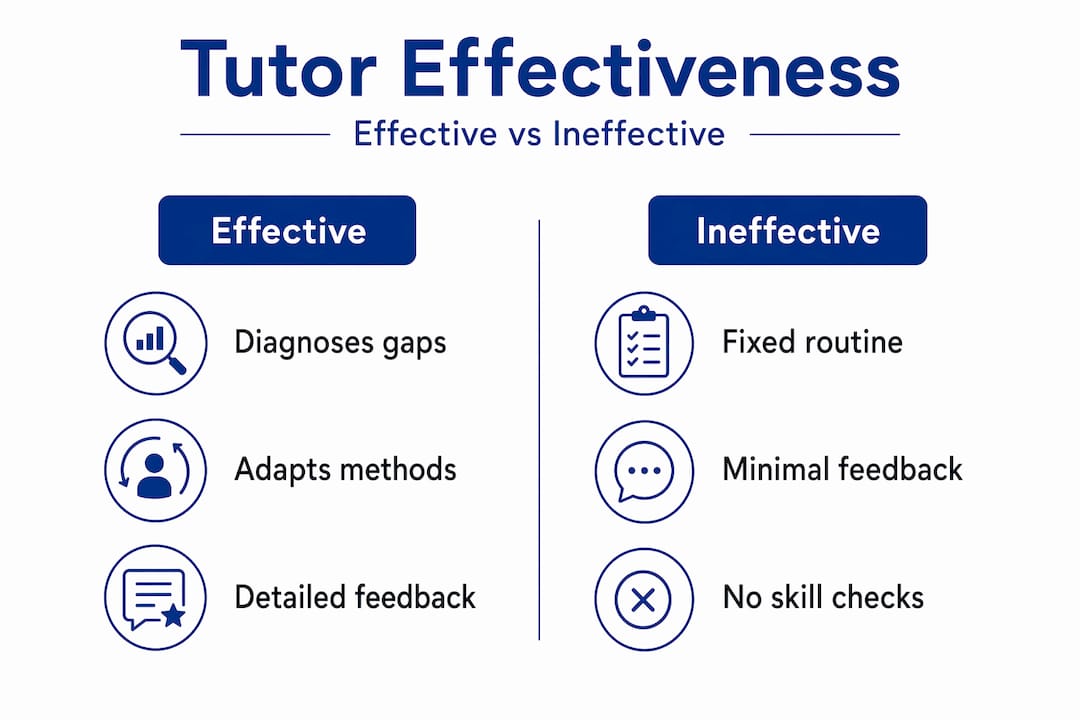
| Effective tutor behavior | Ineffective tutor behavior |
|---|---|
| Diagnoses gaps and adjusts plan | Follows a fixed syllabus regardless of gaps |
| Gives specific, written feedback | Returns work with only a score |
| Tracks progress with data | Relies on verbal impressions |
| Builds reasoning and problem-solving | Focuses only on memorizing steps |
| Communicates proactively with parents | Only responds when contacted |
Pro Tip: Ask your child's tutor directly: "How do you build reasoning skills in your sessions, and how do you maintain a focused learning environment online?" A tutor who can answer this clearly and specifically is far more likely to deliver lasting results than one who gives a vague answer about "covering the syllabus."
For students in N-Level math classes, reasoning exposure is particularly important because N-Level papers test applied understanding, not just formula recall. Look for personalized tutoring approaches that adapt to your child's pace and learning style.
Why most parents underestimate the importance of learning environment
Most parents evaluate tutors almost entirely on grades. That's understandable. Grades are visible, comparable, and tied to real outcomes like school placement. But focusing only on grades can lead you to keep a tutor who drills exam papers effectively while missing a tutor who builds something far more durable.
Singapore's PISA 2022 math performance data is striking on this point. Mathematics performance is influenced significantly by exposure to reasoning tasks and disciplinary climate, not solely by exam preparation. Students who are regularly asked to reason through problems, explain their thinking, and work in a structured, focused environment outperform those who simply practice more papers. This holds true even when controlling for school and socioeconomic factors.
What does this mean for online tutoring? It means the quality of the learning environment your tutor creates in a 60-minute Zoom session matters enormously. Does the tutor set clear expectations at the start? Do they ask your child to explain their reasoning, not just provide the answer? Do they manage distractions and keep the session on track? These are not soft, nice-to-have qualities. They are predictors of real academic improvement.
We've seen this pattern repeatedly. A student who moves from passive note-taking to active problem-solving during sessions often shows a grade jump within two terms, even without increasing the number of tutoring hours. The environment changed. The engagement changed. The results followed.
Parents who focus only on "did my child finish the paper?" miss this entirely. Before you enroll in any program, including primary 4 math classes or higher levels, ask the tutor how they structure their sessions to promote reasoning and maintain focus. Their answer will tell you more than any testimonial.
Find the right online Math and Science tutor in Singapore
If you're looking for a tutor who offers evidence-backed improvement and matches these criteria, here are options to consider.
TutorRaz offers structured, live online Math and Science classes for Singapore students from Primary 4 through O-Level and N-Level. Every session is designed to build conceptual understanding, not just exam technique, with Kahoot quizzes, structured worksheets, and detailed lesson summaries so parents always know what was covered.
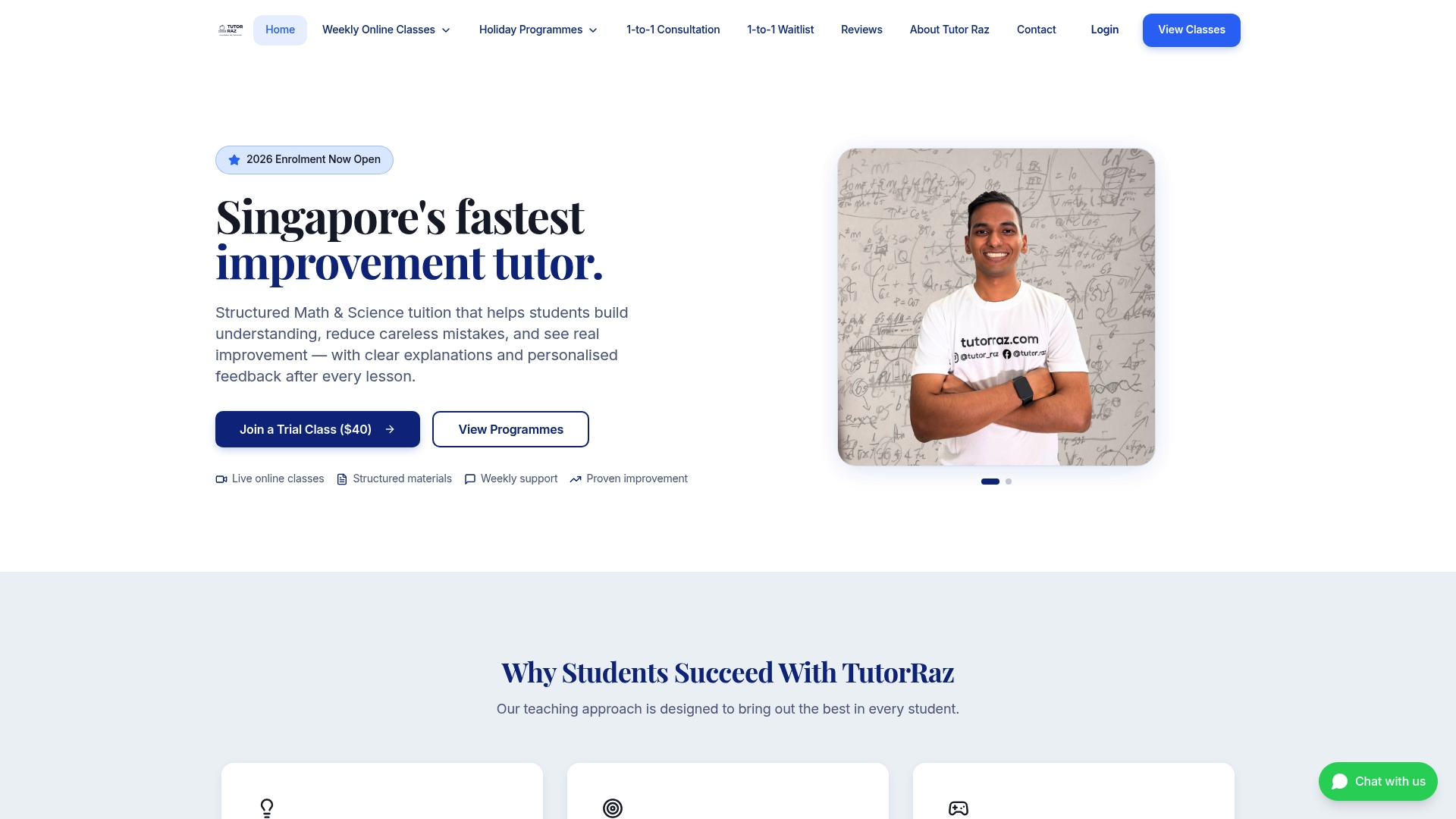
Primary 5 online classes and Secondary 1 online classes are available now, with regular progress updates and parent communication built into every program. If you're looking for more intensive, personalized support, you can also join the 1-to-1 tuition waitlist to secure a spot with Tutor Raz directly. Every class is recorded, every assignment is marked with specific feedback, and every parent receives updates so you can apply the evaluation framework in this article from day one.
Frequently asked questions
How do I know if my child's online tutor is effective in Singapore?
Track academic progress, engagement quality, and feedback specificity across multiple assessments. SLS V2 supports data-informed decisions and can complement tutor reports with school-based performance data for a fuller picture.
What factors should I consider before enrolling my child in online tutoring?
Assess your home environment for supervision, reliable internet access, and your child's readiness for self-directed learning. MOE provides in-school supervised options for students whose home settings are not conducive to focused online learning.
Does online tutoring work as well as in-person tutoring for Math and Science?
Online tutoring can match in-person results when tutors use structured engagement, diagnostic assessments, and specific written feedback. Structured digital teaching enables customization that can actually exceed what a generic in-person session delivers.
How much do Singapore families spend on private tutoring?
Singapore households spent S$1.8 billion on tutoring in 2023, representing a 30% increase since 2018, reflecting how central private tuition has become in the local education landscape.
Recommended
- Fastest Improvement Math & Science Tutor Singapore | TutorRaz - Math Tutor Singapore
- O-Level Online Classes 2026 | TutorRaz Singapore | TutorRaz - Math Tutor Singapore
- Secondary 1 Online Classes 2026 | TutorRaz Singapore | TutorRaz - Math Tutor Singapore
- Secondary 2 Online Classes 2026 | TutorRaz Singapore | TutorRaz - Math Tutor Singapore