

Many parents assume Additional Mathematics is simply a harder version of O-Level Mathematics. That assumption can leave your child underprepared from day one. Singapore's GCE O-Level Additional Mathematics syllabus 4049 introduces entirely new strands, including Calculus, that do not appear in the standard O-Level Mathematics curriculum at all. This guide breaks down what those strands mean, what your child will actually encounter in each one, and how you as a parent can provide meaningful support, even if your own math knowledge stopped at secondary school.
Table of Contents
- Decoding the syllabus: What makes Additional Mathematics unique?
- Tackling the strands: What your child will actually learn
- Mechanics and kinematics: More than memorizing formulas
- Supporting your child's Additional Mathematics journey
- A parent-first perspective: What actually makes a difference
- Ready to empower your child with the right support?
- Frequently asked questions
Key Takeaways
| Point | Details |
|---|---|
| Syllabus structure matters | Understanding the three main strands clarifies what students need to master for success. |
| Concepts over memorization | Deep learning in mechanics and calculus requires modeling and logical thinking, not just formulas. |
| Parent involvement is powerful | Supportive, structured guidance—especially with online resources—can transform a student’s outcomes. |
| Seek help when needed | Professional online tuition and community support can boost confidence and understanding at tough stages. |
Decoding the syllabus: What makes Additional Mathematics unique?
With the confusion addressed, it's essential to see precisely how Additional Mathematics stands apart and why every parent should understand the new terrain.
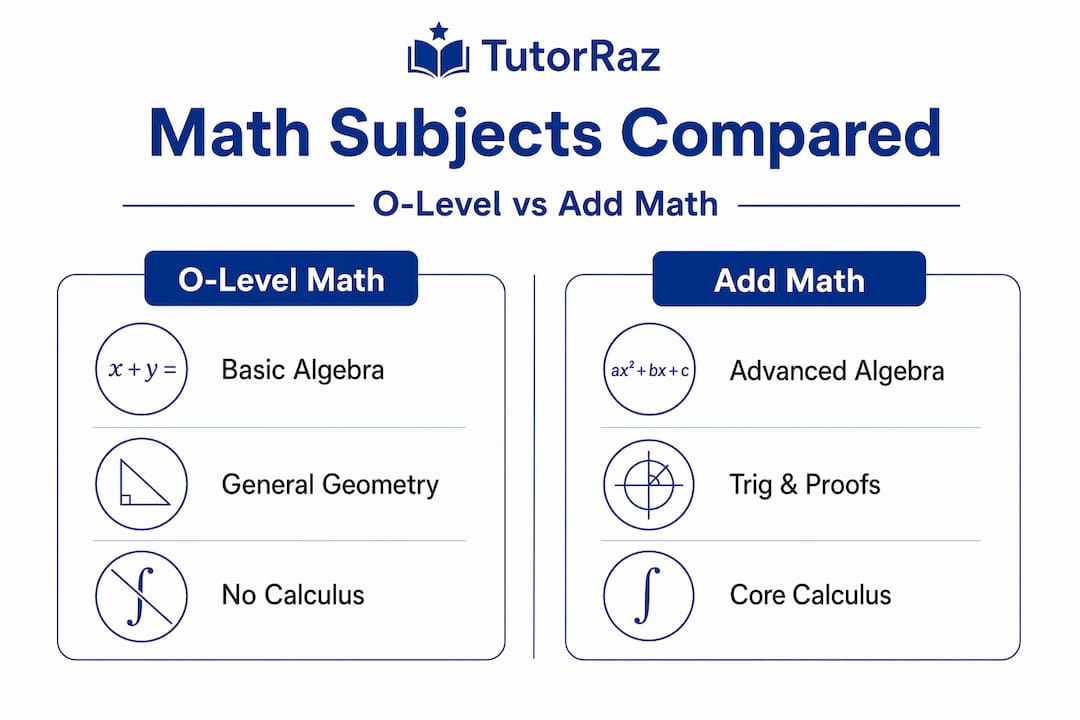
O-Level Mathematics focuses on building numeracy, basic algebra, and geometry skills that most students will use in everyday life. Additional Mathematics, by contrast, is designed to prepare students for higher-level study in science, engineering, and economics at the junior college or polytechnic level. The syllabus 4049 is organized into three strands: Algebra, Geometry and Trigonometry, and Calculus. Each strand builds on the previous one and introduces abstract thinking that goes well beyond what your child encountered in lower secondary.
Here is a quick comparison to put things in perspective:
| Feature | O-Level Mathematics | Additional Mathematics |
|---|---|---|
| Calculus | Not included | Core strand |
| Trigonometry depth | Basic ratios | Identities, proofs, radians |
| Algebra complexity | Linear and quadratic | Polynomials, logs, binomial theorem |
| Proof-based questions | Minimal | Frequent |
| Pathway relevance | Everyday numeracy | JC science and engineering |
The differences are significant. Your child is not just doing more of the same work. They are entering a new level of mathematical reasoning.
Why do these strands matter beyond the exam? Consider this: Algebra at this level trains logical sequencing and symbolic reasoning, skills that are directly transferable to coding and data analysis. Geometry and Trigonometry sharpens spatial thinking, which is central to architecture, physics, and design. Calculus introduces the mathematics of change, the foundation of virtually every engineering and science discipline. Understanding this gives both you and your child a stronger sense of purpose when studying feels difficult.
You can explore how O-Level Additional Mathematics classes are structured to address each strand systematically, so no topic is left to chance.
Tackling the strands: What your child will actually learn
Knowing the three strands is a first step. Now, let's clarify exactly what your child will be learning and where students often stumble.
The SEAB syllabus 4049 covers a wide range of topics across the three strands. Here is a breakdown of the key content areas and the challenges students typically face in each:
| Strand | Core topics | Common student pitfall |
|---|---|---|
| Algebra | Polynomials, partial fractions, binomial theorem, logarithms, exponential functions | Confusing log laws; errors in binomial expansion |
| Geometry and Trigonometry | Trigonometric identities, proofs, coordinate geometry, loci | Skipping proof steps; not memorizing key identities |
| Calculus | Differentiation, integration, applications to area and kinematics | Applying rules without understanding when to use them |
Let's look at each strand more closely.
Algebra in Additional Mathematics goes far beyond solving for x. Your child will manipulate polynomials, work with surds, and apply the binomial theorem to expand complex expressions. Logarithms and exponential functions are introduced here, and many students struggle because they try to memorize rules without understanding why those rules work. The fix is to practice deriving the rules, not just applying them.
Geometry and Trigonometry introduces trigonometric identities and proofs, which require a completely different mindset from calculation-based questions. Students must learn to work backwards from a desired result. Loci problems, which ask students to describe the path traced by a moving point, are another area where spatial reasoning is tested in ways that feel unfamiliar.
Calculus is often the most intimidating strand for both students and parents. Differentiation asks: how fast is something changing? Integration asks: what is the total accumulation? Both concepts have real-world applications that make them easier to grasp when explained with context. The challenge is that many students rush into formulas without building intuition first, which leads to errors in more complex questions.
Here is a practical sequence for approaching each strand effectively:
- Build foundational fluency before attempting harder questions. For Algebra, this means mastering index laws and factorization before moving to logarithms.
- Use worked examples to study the structure of solutions, not just the final answer.
- Attempt questions without looking at solutions first, even if you get them wrong.
- Review errors systematically by keeping a short error log noting the type of mistake made.
- Revisit weaker topics weekly rather than cramming before tests.
If your child is in Secondary 3, reviewing Secondary 3 Add Math syllabus topics early in the year gives them a significant head start. And if their Secondary 2 Math foundation has gaps, addressing those first will make the transition far smoother.
Pro Tip: Encourage your child to write out the reasoning behind each step, not just the calculation. Students who can explain why a step works are far less likely to make careless errors under exam pressure.
Mechanics and kinematics: More than memorizing formulas
After tackling the main strands, let's focus on one of the most misunderstood sections: mechanics and how kinematics ties formulas to concepts.
Kinematics is the study of motion without considering the forces that cause it. In the context of Additional Mathematics, it connects directly to Calculus and is one of the most conceptually rich topics in the entire syllabus. Many students treat it as a formula sheet to memorize, and that approach almost always backfires.
Here are the three core quantities your child needs to understand deeply:
- Displacement (s): The distance from a reference point, with direction. It can be positive or negative.
- Velocity (v): The rate of change of displacement. Velocity is the derivative of displacement with respect to time.
- Acceleration (a): The rate of change of velocity. Acceleration is the derivative of velocity with respect to time.
The relationships between these quantities are what make kinematics a calculus topic, not a physics formula topic. Velocity-time graph features show this clearly: the gradient of a velocity-time graph gives acceleration, and the area under the graph gives the change in displacement. These are not arbitrary rules. They are direct applications of differentiation and integration.
"The most reliable way to approach kinematics is to anchor learning to the syllabus strands and treat it as a calculus-connected modeling topic, rather than as a formula-only unit." This perspective, grounded in the SEAB syllabus 4049, is what separates students who truly understand the topic from those who guess under pressure.
When your child works through a kinematics problem, they should be asking: am I differentiating or integrating here, and why? That question alone shifts the thinking from mechanical substitution to genuine reasoning.
Pro Tip: Ask your child to sketch a simple velocity-time graph for any kinematics problem before writing a single equation. This habit builds visual understanding and reduces formula confusion significantly.
For more strategies on building this kind of conceptual thinking, the Add Math strategies section on our blog covers problem-solving approaches across all major topics.
Supporting your child's Additional Mathematics journey
With the key content areas covered, how can you best help your child succeed, especially if Additional Mathematics seems overwhelming?
The most important thing to understand is that your role is not to teach the mathematics. Your role is to create the conditions in which your child can learn effectively. That is a meaningful and achievable goal, regardless of your own math background.
Here is a structured approach to supporting your child through the year:
- Track progress strand by strand. At the start of each term, ask your child which strand they are currently studying and how confident they feel. This keeps you informed without requiring you to understand the content itself.
- Normalize struggle. Additional Mathematics is genuinely challenging. A student who finds it hard is not failing. They are learning. Reframe difficulty as a sign that real thinking is happening.
- Create a consistent study environment. Dedicated study time, a quiet space, and limited distractions matter more than any single resource or tuition class.
- Use structured online resources. Live online classes with lesson summaries, recorded sessions, and regular quizzes give your child multiple ways to engage with the material. This is especially valuable for topics like Calculus where a single missed lesson can create lasting confusion.
- Review feedback together. When your child receives marked work or test results, sit with them and look at the feedback. You do not need to understand the math to ask: "What did you learn from this mistake?"
- Know when to seek formal support. If your child is consistently scoring below 60% on tests, struggling to complete homework independently, or expressing significant anxiety about the subject, structured tuition is worth considering seriously.
The syllabus 4049 structure is demanding, but it is also logical. Students who understand the connections between strands, rather than treating each topic as isolated, consistently perform better. That kind of connected understanding is exactly what structured Add Math support is designed to build.
Pro Tip: Set a monthly check-in with your child where they explain one concept they have recently learned in simple terms. If they can teach it back to you clearly, they understand it. If they cannot, that is a signal to revisit the topic with their teacher or tutor.
A parent-first perspective: What actually makes a difference
The strategies above are useful, but experience reveals there is a deeper truth that most guides for parents miss.
Real improvement in Additional Mathematics does not come from drilling every topic in isolation or signing your child up for every available tuition class. It comes from nurturing independent thinking. Students who learn to ask "why does this work?" rather than "what formula do I use?" are the ones who perform consistently well, not just on topics they have practiced, but on novel questions they have never seen before.
Here is the uncomfortable truth: over-involvement from parents often slows progress. When a parent checks every piece of homework, provides answers when the child is stuck, or panics visibly at a poor test result, the child learns to rely on external rescue rather than internal resilience. That pattern is very hard to break by the time O-Level exams arrive.
The most effective parents we have worked with at TutorRaz share a common trait. They stay informed without hovering. They ask questions without providing answers. They celebrate effort and process, not just grades. And they trust that setbacks are part of the learning curve, not signs of failure.
There is also a tendency to assume that more hours of study equals better results. That is rarely true for Additional Mathematics. Focused, active practice for 45 minutes is worth more than two hours of passive reading or copying notes. Help your child understand the difference between feeling busy and actually learning.
Finally, confidence matters enormously in mathematics. A student who believes they can improve will attempt harder questions, learn from mistakes, and persist through difficulty. A student who has internalized the belief that they are "not a math person" will avoid challenge and plateau. Your words and reactions as a parent shape that belief more than any tutor or teacher can.
Ready to empower your child with the right support?
If the content above has helped clarify what Additional Mathematics actually involves, the next step is finding support that matches your child's specific needs and learning style.

TutorRaz offers O-Level online tuition for Additional Math designed specifically for Singapore students following the SEAB syllabus 4049. Classes are conducted live via Zoom, with detailed lesson summaries, structured worksheets, and Kahoot quizzes to keep students actively engaged. Every lesson is recorded so your child can revisit explanations at their own pace. Progress is tracked regularly, and parents receive updates so you always know where your child stands. Whether your child needs foundational rebuilding or exam-focused practice, you can explore enrollment for weekly classes and find the right fit today.
Frequently asked questions
What are the main strands of O-Level Additional Mathematics?
The SEAB syllabus 4049 is organized into three strands: Algebra, Geometry and Trigonometry, and Calculus, each building progressively toward higher-level mathematical thinking.
How does kinematics fit into the Additional Mathematics syllabus?
Kinematics is taught as a calculus-connected mechanics topic, where students use differentiation and integration to analyze displacement, velocity, and acceleration relationships and interpret velocity-time graphs.
Is Additional Mathematics required for junior college (A-Level) admission?
Most junior college science streams require or strongly recommend a strong O-Level Additional Mathematics result, particularly for students intending to take H2 Mathematics or science-heavy subject combinations.
Can parents guide their children without a math background?
Absolutely. By understanding the syllabus structure, asking the right questions, and supporting consistent study habits, parents can play a powerful role in their child's progress without needing to know the mathematics themselves.
Recommended
- O-Level Online Classes 2026 | TutorRaz Singapore | TutorRaz - Math Tutor Singapore
- Fastest Improvement Math & Science Tutor Singapore | TutorRaz - Math Tutor Singapore
- TutorRaz Insights & Strategies — Math & Science Tuition Tips Singapore | TutorRaz - Math Tutor Singapore
- N-Level Online Classes 2026 | TutorRaz Singapore | TutorRaz - Math Tutor Singapore